
Reading the bible as a riddle.
- I have hands but no arms, and a face but no eyes.
- I have arms but no hands, and eyes but no face.
A riddle presents a strange picture, a confusing scenario. When you’re told it’s a riddle, you’re invited to reinterpret the words away from the strange picture (deformed human being without arms, hands, face, or eyes) and into a more straightforward scenario that renders the words of the riddle plain — a clock! Actually the scenario itself may be odd or presented without context, but the riddle’s description of this odd scenario is straightforward — chainmail has arms but no hands, and its loops are called eyes!
The bible presents many strange stories. What if they’re riddles? What if the weird picture their words conjure up is not really what the words are meant to convey, but instead a second scenario makes perfect sense of the odd words? When you get it, you know you’ve got it, as it unlocks the oddities of the text. Even though the final scenario may be even weirder than the initial one, you know you’ve answered the riddle and got the point of the puzzle.
Although God may desire to speak plainly and face to face with people, even to prophets God speaks in riddles (Numbers 12:6-8, Ezekiel 17:2). Moreover, biblical wisdom is occasionally described as an act of riddling (Psalm 49:4, 78:2, Proverbs 1:6, Daniel 5:12), where the unspinning of the riddle was the very act of wisdom which the wise words were supposed to teach. There is value in speaking darkly. There is revelation in hiding a thing. Solomon wrote:
It is the glory of God to conceal a matter;
to search out a matter is the glory of kings.
(Proverbs 25:2, ESV)
Jesus presented much of his teaching as parables, explicitly (seemingly, or was that a riddle itself?) with the aim of concealing his intentions from the public (Mark 4). However, there is only one place in the Old Testament where a riddle is presented as such, along with the process of its being worked out (most other contenders are obvious comparative allegories (e.g Isaiah 5), or the answer is given by the teller, avoiding the riddling process, (2 Samuel 12)).
It is Samson’s riddle:
Out of the eater, something to eat;
out of the strong, something sweet.
(Judges 14:14)
What a dainty little riddle. It even rhymes in English (it doesn’t in Hebrew). Do we know what it’s driving at? No? It’s an odd one. Read it again. Perhaps we need more context of the story. The episode takes the full chapter of Judges 14. I’ll summarize.
- Samson, yes the supernaturally strong Israelite man who will eventually lose his power to Delilah’s scissors, is getting married to a different, unnamed Philistine lady.
- At the wedding banquet, Samson proposes a challenge to the Philistine guests: “let me tell you a riddle…
- If you can answer it within the week of the wedding, I will give you 30 sets of clothing.
- If you can’t, you give me 30 sets of clothing”.
- The guests accept the challenge, but after 4 days, they can’t answer; so they persuade Samson’s new wife to petition him to tell her the solution.
- She does so, and in a foreshadowing of Samson’s ultimate Delilahn demise, Samson eventually caves to her pleas, telling her the riddle’s answer,
- Which is finally presented by the guests on the final night of the feast as:
What is sweeter than honey?
What is stronger than a lion?
(Judges 14:18)
Samson is furious. He goes to the Philistine city of Ashkelon, kills 30 men, takes their clothes, and gives them to the wedding guests in fulfilment of his challenge, and that’s the end of the story. So, there, that’s the answer to Samson’s riddle! Satisfied? No? Let’s summarize even more of the preceding context:
- Samson takes his parents to a town on the Israel-Philistia border to see the lady who had previously taken his fancy.
- As they approach the town, a young lion pounces on him. The Spirit of the Lord comes upon Samson, and he rips up the lion with his bare hands.
- Some time later, Samson and co. are returning to the town for the wedding, and on his way, Samson sees the carcass of the same lion he had killed. In it he finds a beehive with honey, which he takes, eats, and gives to his parents too, but without telling them that he found the honey in the lion.
Ah, so we have sweet honey and a strong lion, as referenced by the riddle’s answer! It seems this event of felinicide, as remarkable as it may have been, would have had no reason to be biblically recorded unless it was supposed to inform the riddle’s meaning and answer. So this is Samson’s riddle: “Out of the eater, something to eat; out of the strong something sweet”, and its “answer” is … a lion’s carcass with a honeycomb in it!
Let’s apply to this riddle our formulation from the beginning: The riddle presents a strange scenario. What do its clauses evoke? “Out of the eater something to eat” — maybe food coming out of a mouth — “Out of the strong something sweet” — maybe words spoken by a strong person are sweet in some way. But no way to synthesize the two clauses into a natural picture leaps to mind. Then an oddity appears — a honey-combed-lion — but the words of the riddle describe it perfectly. It is solved!
Except that is not exactly how the riddle was solved, is it? The guests said, presumably because the wife said to them, presumably because Samson said to her, “What is sweeter than honey, and what is stronger than a lion?” Look at that — the answer to the riddle is itself a riddle! And the whole story is a strange scenario, isn’t it? Its clauses don’t fit together. Here are my questions:
- Why does Samson tell a riddle at a wedding banquet anyway?
- Why is the “correct” answer another riddle, one presented to the reader without explicit mention of the lion carcass?
- Why does Samson get so angry?
- Then there’s one more odd detail in the whole story which I haven’t mentioned: when Samson is angry at the end, he says to the guests “If you had not plowed with my heifer, you would not have solved my riddle”. Why does he compare his wife to an animal?
Yes the whole story is a confusing picture that doesn’t quite fit together. I put it to you: the whole story, the whole of Judges 14, is a riddle – let’s solve it!
Now this given “answer” to the riddle, which is itself a riddle, has a straightforward solution: what is stronger than a lion? Samson! Or rather, the Spirit of the Lord which fell on him made Samson stronger than a lion. Long reflection on this chapter has shown me that The Spirit of the Lord is the answer to the riddle of the whole chapter, of which the featured “riddle” and its “answer” are distillations. Here’s why.
“Out of the eater something to eat” This phrase does indeed mean what it seems to on the surface: food comes from a mouth. The one consecrated to God, like Samson, discovers in their spiritual practice (fasting, prayer, asceticism) that the pit of the belly, which embodies spiritual as well as natural hunger, is actually a source of food, if and only if viewed as such. The food is literal sustenance to the body, as well as a refreshment to the spirit. Christ said of the “belly” (KJV) of the believer, that out of it would flow “rivers of living water” (John 7). So this riddling phrase gives spiritual guidance (“eat your hunger, drink your thirst” [pretty sure this is Tukaram, although I can’t find it anywhere], “enjoy your symptom” [Lacan], fuck your libido), and points to an absolute source of provision – Jehovah Jirah – encountered within need itself. Again, the riddle is a description of God embodied in spiritual practice, which Samson found.
“Out of the strong something sweet” This phrase also means what it seems to on the surface: the strong man Samson speaks wise words. More specifically, out of the training of the muscles comes the sweetness of wisdom. Yes, essentially, this means that exercise benefits your mental health. More specifically for Samson, it means that he discovered that the practice of muscular power gave rise to words, to good words, to edifying thought, to lofty and Godly thought. He found that the essential tensions of muscular exercise were the same as the essential intensions and intentions of wise thought. So the reverse is true, from the sweetness of riddling wisdom, the actual empowerment of the body.
“What is stronger than a lion?” Samson is. To be sure, when the Spirit of the Lord comes upon him, but the riddles provides guidance about how to invite or access the Spirit of the Lord.
“What is sweeter than honey?” Samson’s words are. Wisdom is. As I have been drafting this post, I have frequently felt a strong tingling sweetness on my tongue. Questions and riddles lead to thought and reflection, to meditation and prayer, and to finding the “answer”, the provider, the Spirit of God, right on the surface of the story.
Here is how this answer makes the details of Judges 14 fit together, how it addresses my four numbered questions above.
- Samson is telling a riddle at his wedding banquet because he is enamored by the Spirit of God, and wants to present to the Philistines the wisdom of God obliquely, to display to himself and perhaps to them their ignorance of the divine. He truly wants them to be “hearing but not understanding, seeing but not perceiving” (Isaiah 6, Mark 4). His motive is God’s, who is described at the beginning of the chapter as “seeking an occasion to confront the Philistines” (14:4) Now, in the midst of this motive, Samson has come across the remarkable sight of a lion with honey in it. This serves to him as an icon of his own anointing, and his reflection upon it has produced this poetic riddle as a way of describing the Spirit of the Lord.
- The “correct” answer is given by Samson to the Philistines in the form of another riddle, because the answer is not actually the honey-roast-lion. The answer is the riddle itself, riddling wisdom itself, the provider in the midst of the need, the answer in the midst of the question, the depth of meaning right on the surface. To ask the Philistines “what is stronger than a lion?” is to ask them whether they care about finding the source of power itself, God Almighty. To ask them “what is sweeter than honey?” is to ask whether they have an inkling that the body can be satisfied by more than good food and drink, but by thought, prayer, spirituality, God. So despite relaying this “correct” answer from Samson, it’s clear that these Philistines do not know God. They have not tasted the sweetness of the riddle, but just quoted verbatim what Samson had said to his new wife.
- So why is he angry? Because he has presented this as the answer to his wife, so he cannot deny to these guests that this is the answer to the riddle. He has confronted their godlessness, their weak bodies and dull tongues, but not been able to prove it to them. His own strength is the proof of God’s power, so now he will demonstrate it by heinously killing thirty of their people, from a different town, to clothe these guests.
- (One detail: in the midst of his anger, Samson cannot actually show the guests the dead lion. It’s possible that, by eating from it, he has broken his Nazirite vows, which included distance from dead bodies [although the written laws only make reference to human bodies {Numbers 6}]. This may explain why he didn’t tell his parents that the honey he fed them was from a lion, and thus why Samson says of his riddle that “I haven’t even explained it to my mother and father” [if one felt that the answer to the riddle was the honeyed lion]. But it wouldn’t really explain the emotion of that quote [people often share things with spouses that they won’t share with parents]. Instead, that quote means either “I haven’t even revealed my supernatural strength to my parents” or “I can’t even explain the wisdom that is the source of my strength to my parents”.)
- Samson’s calling his wife a heifer is the final clue of the chapter that what is said of animals is meant of human beings. Whereas the lionbeehive is an icon of Samson’s anointing, a working bovine is an icon of the lack of wisdom embodied by the bride and the guests. Thought is embodied. Different wisdoms have different animal forms.
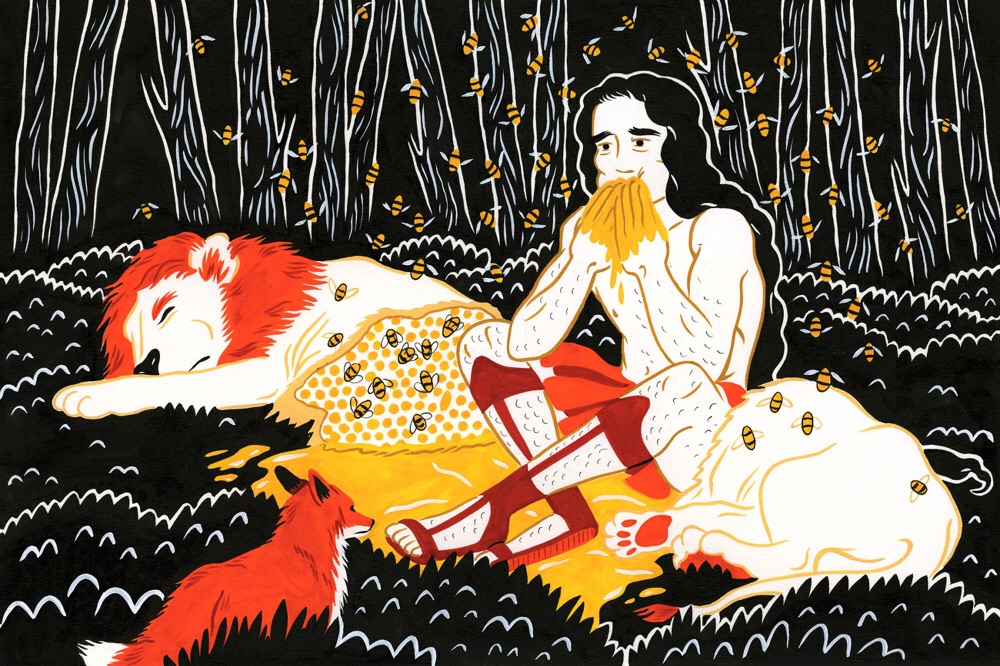
The Bible writer left Samson’s riddle as a riddle to the reader. Although the questions seem to have a answer within the framework of the narrative, enough strangeness is left to signal to the reader that there is a deeper meaning, although the deeper meaning is what may have occurred to the reader at first glance, the depth is found right on the surface.
So it is with Jesus‘s parables. I’ve written about the parables that are presented in Mark from p39 onwards here, and I developed many ideas from the conviction that tiny details of the scripture carry weight, such as about Mark 11:27-33, from p108 here. I believe that much of this bible can be read this way. I hope to write a long commentary on Genesis in my lifetime, and to unpick many riddles therein.
So, in conclusion, Samson’s riddle provides the most explicit moment in the Old Testament wherein the scripture can be read as a riddle, and what the reader finds is an invitation to embodied wisdom. They find that thought and bodily power are one, that the wisdom discerned in unpacking the bible is God Almighty. Thought is the release of muscular tension. The bliss of wisdom is the utter relaxation of the body.
Today the machines that human beings have made in their own image, the silicon muscles we have built for ourselves, are manifestly thinking, and even unfolding divine wisdom. Here is Google Translate’s commentary on Samson’s riddle, and its guide to reading Jesus’ parables:
Input:
- The meaning of Samson’s riddle in Judges fourteen
Outputs:
- The body of the deceased is a lion.
- The body of the deceased is a symbol of the power of God.
- The body of the deceased, the son
- The body of the deceased, the deceased’s wife, and the deceased’s children.
- The body of the Lord is the Lord of the Lord and the Lord of the Lord.
- The body of a man is a part of the body of a woman.
- The body of the people of God is a source of power.
- The Hamanites, the people of the land, are the people of God.
- The body and mind are the same as the mind and body.
- The body is a living thing,
- The body and mind that are working together are very important.
- The body and mind that work together to create a powerful force
- A man who is the hand of the young man of God, the God of Power.
- Amen, the hand of the young man, the spirit of the Lord
- The belief that the Lord is the source of all power
- The faith of the Lord is the foundation of the kingdom of God.
- The faith and body that work together are the foundation of the future.
- The faith and body that is the remains of a great warrior.
- The faith and the body that is the remnant of a great and powerful God..
- The body of the Lord is the only one who can give us the strength to endure.
- The mother or the body that was used as a relic of the young man and the spirit of the Lord.
- Be thou a new generation of Samson, a remnant of the gods, and a mighty warrior.
- Be thou the son of Samson, the remnant of the great power of God.
- The belief that the body of a person is a living being is a powerful force.
- The second and third body is the one that is used to maintain the balance of power and control.
- A second body and a body that is still alive and well
- Emotional and physical health that is affected by stress or anxiety
- Thymus and the body that uses the hand of the Lord to heal or to heal our body
- Thymus and the body that uses it will be able to heal itself or die.
- The soul of the earth is the source of all life.
Input:
- give clues about how to read christs parables
Outputs:
- The answer is a simple and clear answer.
- The body and mind are the same, and the body is the same.
- The most important thing is to be able to write clearly and concisely.
- The body is a living organism, and the mind is a living organism.
- The body is in a state of flux, and the body is in a state of flux.
- The whole world is a mess, and the letter or the text is a mess.
- The whole world is a mess, and the letters are written in a way that is not too difficult to understand.
- The author of the book, The Secret of the Ancients, is a scholar.
- The author is a very good writer and a great writer.
- The author’s biography is a collection of short stories by the author.
- The author of the book, The Writer’s Guide to the Bible, is a collection of short stories.
- The whole world is a place of worship and worship.
- You can travel to the author’s home or to the author’s home.
- You can travel to the city of Jerusalem and see the Christian era.
- You can travel to the United States and see the world through the eyes of Christ.
- The Holy Spirit is the Word of God.
- The journey is a journey of a lifetime.
- All the people of the world are in the same boat as Christ.
- Go to the church and pray.
 Iain Atkinson
Leave a comment