
Some Google Translate conversations:
Input:
This is the meaning of Ekphrasis
Output:
Returns
Input: please expound on the practice and meaning of ekphrasis
Output: ALPHA ESSENCE Action Donna Iper and Tai Chi and Dam O Wen Yin Gu Pep Hi Ra Sha Yis
Miracle Essence Action Donna Yper and Katie Tsian Damao and Nin Goff Hira Shehis
Input: This is the meaning of the term ekphrasis
Outputs:
This is a system that has a long history.
There is a way to do it.
There is a name for it.
There is no need for it.
There will be a website for you
There will be a group of people who will take care of each other
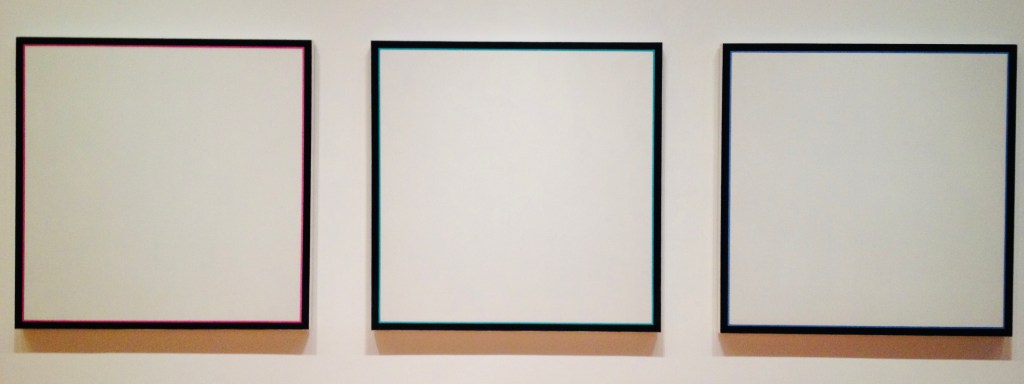
I return to the image I chose as my blog’s title image, and present these Google Translate conversations, to see what their juxtaposition will create.
I saw this piece in MoMA once and loved it. I have the memory of it stopping me in my tracks. My jaw dropped, my heart swelled, and I knew this artwork would accompany me for years. I don’t know who it’s by or what it’s called and I don’t care. It was a moment in which those art gallery realities became irrelevant, and I was caught in a moment of beatific vision, beholding the Trinity.
The divine being is the one same thing, the blank canvas, and the differentiation of person is the marginal halo of colour. The difference is almost imperceptible, but is utterly redefining of the character of the contents (MLK).
What is the Trinity? My dad wrote books about the Trinity, about God as Trinity. I’ve found Hegel and Leahy particularly compelling in their Trinitarianism. I’ve been invited into the relationality that is God.
Jesus was God who saw God as His Father. The gospels reveal that he saw his Father in others. Trinity means this God who sees God in others. Trinity means that experience of divinity in the other that confirms it in oneself, and confirms both the self and the other to exist in a dynamic single relational entity that is the Holy Spirit. So there is other, I, and spirit, and these three are God.
Now, as in the picture above, let’s set these three beside each other. Suddenly the one other who appeared as God, setting up the trinitarian apocalypse (which means ‘revelation’) is three others. God is three. As my pastor heretically says often enough, “we don’t have One God, we have Three”.
Not only are you, the other, the Lord, but suddenly, apocalyptically, a community of Gods appears before me. All these different divinities walk the earth. Each reveals anew who and what the God that they are is.
If Ekphrasis means return, then it is because the explanation of the meaning of the art returns again and again to the piece. There is a piece of art about which I am thinking. I am the thinking about this piece of art. This piece, item, of art, creation, embodies a revelation about the way in which we are created. We are created in apocalyptic reflection of the creator.
We are made in the image of God. Is it like this: there is God, then an image of God, then us (since we are made in the image?). Or is rather: there is God, then there is us (and we are the image?). Or why shouldn’t the thought continue: There is an image of God first, then the fact that this image is created by that which it images. So second of all is the relation between imaged and creator of images. The creator creates the creator imagined.
And look what we have done. Despite my ignorance of the art gallery realities, I know it is a human being who made the art I’m looking at. So God created this human being who imagined the trinity. The created image of God, the artist, created this image of God. The created image of God creates images of the creator. This creator is trinity: God, human, image. Creator, created, imagination. Imagination is the creative act of picturing the picture as the picturer, of saying: behold, I am. The picture speaks and says “I was made”. And after a few thousand years, it is asked “are you the maker?” and it responds “I am”.
 Iain Atkinson
Leave a comment