
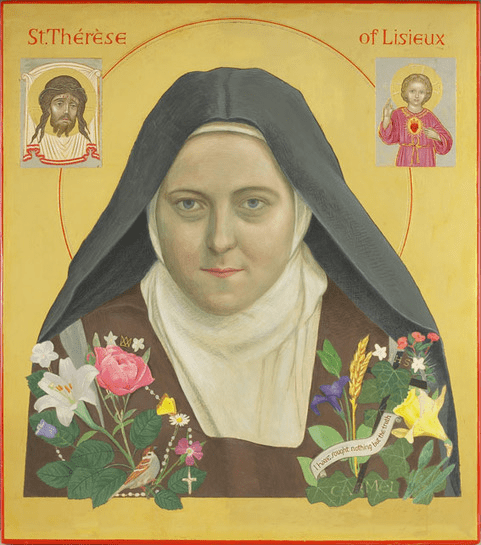
Three faces, some flowers, and a sacred heart. This sweet, unimposing icon does not ask to be front and centre in a place of worship, it does not call for prostrations or candles, it just gently draws darting eyes to the soft gaze of Saint Therese of Lisieux.
Saint Therese of Lisieux lived a short life in a convent in Normandy at the end of the 19th century. Known as “God’s little flower”, she inspired many with her humble and beautiful love for Jesus. The flowers in this icon also represent the way God spoke to her through the beauty of nature. She says of one of her walks in a field “I understood that every flower created by Him is beautiful, that the brilliance of the rose and the whiteness of the lily do not lessen the perfume of the violet or the sweet simplicity of the daisy. I understood that if all the lowly flowers wished to be roses, nature would no longer be enameled with lovely hues. And so it is in the world of souls, our Lord’s living garden”. What more need one know about this woman’s life or faith in order to admire her? As I, knowing so little of her, can admire her simple faith, and believe in her example, so in seeing this simple icon can I be inspired in the simple faith its beauty represents. Aren’t we all called to a simple faith in a simple gospel?
An icon of icons, this image shows us two icons of Jesus which were of particular importance of Saint Therese: the child of sacred heart, and the Veil of Veronica. This latter one is also, in a way, an icon of an icon. The story goes that Saint Veronica encountered Jesus as he carried his cross on the way to Calvary. She wiped his face with a cloth, which, becoming sweaty and bloody, left his image imprinted on the cloth. When she later travelled to Rome and presented the image-bearing cloth of Christ to the emperor Tiberius, the faith that it stirred up produced many miracles. So Veronica’s cloth was an image of Christ which then became the subject of many iconographic images throughout Catholic history. Evidently important to Therese, it appears now on this image. The image of Christ. The image of the image of the image of Christ. The passed on and passing on image of the image of the invisible God. How does it form an image of God in us? How can an image of the invisible God form in us who look at icons, pictures of saints made in the image of God?
Both Veronica’s veil and the child Christ with sacred heart represent the simplicity of faith. In the gospels, Jesus brings children to himself to display them as examples of pure faith. He goes on to carry his cross as the historically singular display of the greatness of faith, total submission to the will of God, even unto death on a cross. Faith as innocence, and faith as submission. Simple images of simple faith. It is curious that, in this icon of Therese, the Veil of Veronica and the child’s heart are not presented the other way around. As it is, they are out of chronological order. They represent, in this icon, not the progression of Christ’s life on earth, but the immediacy of his whole life in the life of a believer, a saint. They are both immediately in the sight of this saint who gazes at us – we who, if we submit, innocently enough, find ourselves believing, saintly. All of us who are drawn to the image of the invisible God are being restored in His image in which we were made. Images of the invisible cannot be carbon copies. We are diverse flowers in God’s living garden, “enameled with lovely hues” – those are painting words – we ourselves are icons, painted flowers, on the canvas of God’s creation, drawing each other’s gazes through and beyond ourselves.
So return finally to the gaze of Saint Therese. The red halo encompasses it, the flowers point up to it, and Christ willingly points down to it – to her gaze. Where does she look? Mona Lisa-esque, she looks just beyond us, to our left. She looks at us, but not quite. She looks at Christ, who is dying but living in her submissive but innocent look. So must we look: beyond the given image to see in and as the seeing the simple flower of the heart of God.
 Iain Atkinson
Leave a comment